Kyoto travel guide
A practical guide for first-time visitors to Kyoto, Japan's old capital and the cultural center of the country.
Kyoto, Japan
The old capital
Kyoto is pretty much an essential stop for cultural tourism in Japan. The city was the imperial capital for more than a thousand years, and a lot of that history is still standing. If you arrive here from Tokyo or Osaka, Kyoto feels like a different country from many perspectives.
The city is famous for its Zen gardens, Buddhist temples, torii gates and traditional wooden houses. It is the perfect place to experience the roots of the Japanese culture, from the food and the tea ceremonies to the world of geishas.
You need around 3 or 4 days if you want to cover the main spots. Even though the city is not massive, its major attractions are spread around and public transportation is not as efficient as in Tokyo or Osaka. There are a few subway lines and a ton of regional trains to travel in and out of the city as well as an extensive bus network. Walking works well inside a single district, but plan a bus or train between them.
We visited during sakura, the cherry blossom season. However, the cherries in Kyoto were not in full bloom as they opened a bit later than expected that year. The weather was also not the friendliest, with rain here and there, but the city is beautiful no matter what.
Buddhist temples
The two main religions in Japan are Buddhism and Shinto. Both are heavily represented with beautiful shrines and temples in Kyoto. The Buddhist temples have decorated gardens around them, which is part of why they are so popular in high season.
Temples are recognized by the presence of Buddha statues, either outside or inside the main building. Shrines are more open and don’t have large closed buildings. They are impossible to miss because of the torii gates — usually painted bright red — that you pass under on the way in.
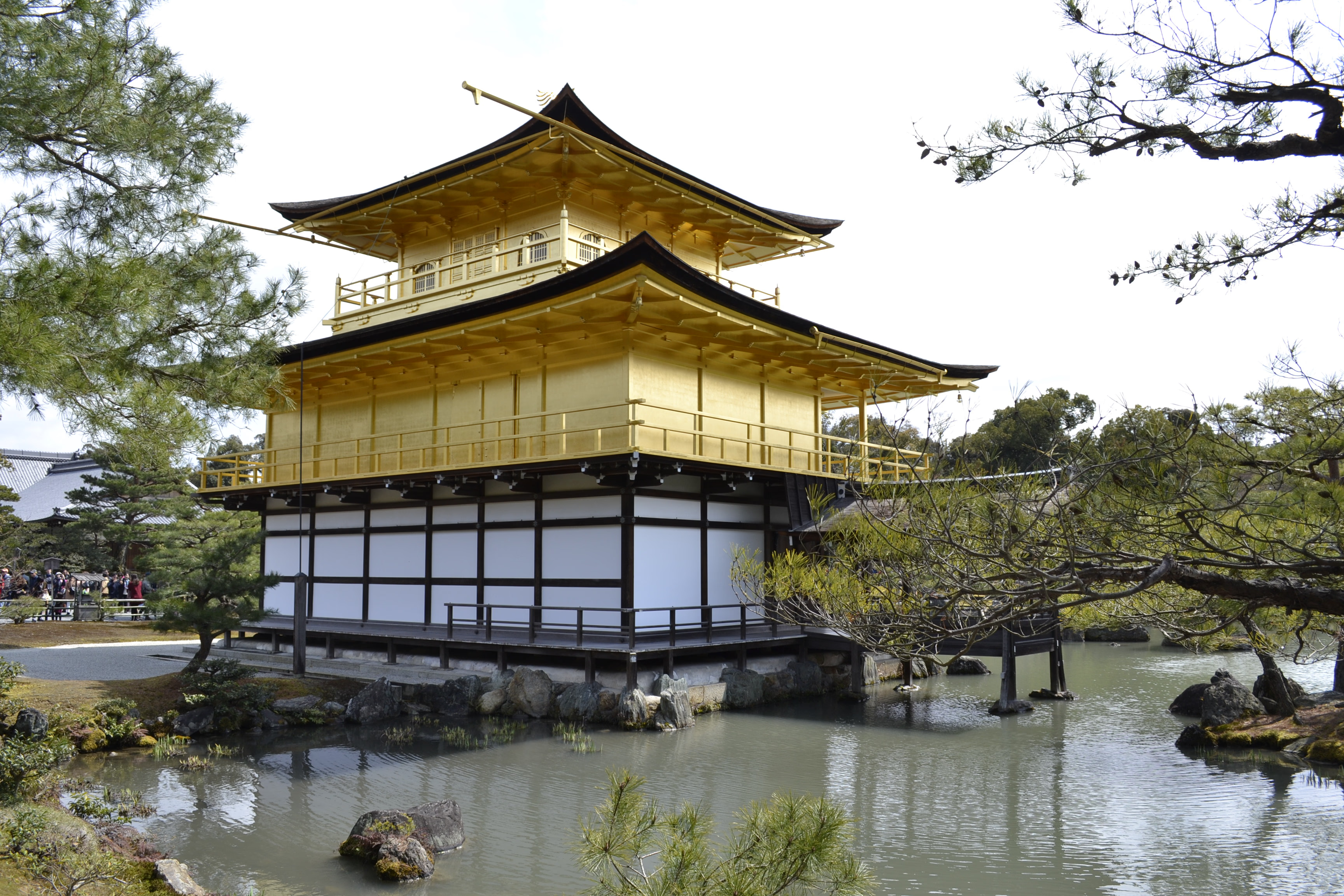
Kinkaku-ji, the Golden Temple, is one of the most famous sights in Kyoto. It is situated in the western part, in an area well connected to the rest of the city by public transportation.
Its gold-leaf hall reflected in a pond, with a large open garden around it is the perfect representation of Zen Buddhism. It is busy and quite popular with tourists but doesn’t require more than 30 minutes to an hour to visit, so it’s a good place to start a day here.
Ryōan-ji is famous for its dry rock garden: a large rectangular area with white pebbles and fifteen stones arranged in five groups. Fun fact, the stones are arranged in such a way that you cannot see all of them from any single spot.
Because this one is close to Kinkaku-ji, it also attracts a lot of visitors. It is also quite small and tight, since access to the actual garden is limited and you only have a narrow hallway to walk back and forth.
Moving east now, Ginkaku-ji, or the Silver Pavilion, is a much quieter alternative for a similar size Buddhist temple. The really impressive feature of this temple is its meticulously designed garden. It has a lot of different paths criss-crossing the light green grass and moss fields.
It is quite astonishing to learn how everything is planned to perfection inside these Zen gardens, while the end result looks like a 100% natural landscape. The garden also features a pond and it even has a raked gravel area, though much smaller than the one at Ryōan-ji.
South of Ginkaku-ji, the Philosopher’s Path is a popular walking trail that follows the Lake Biwa Canal toward Nanzen-ji. It is a nice way to relax while walking along the canal, lined with cherry trees.
Kiyomizu-dera sits on a hillside in the east of the city, with a wooden stage looking out over the rooftops. It is also one of the most iconic sights in Kyoto, but unfortunately it was under heavy renovation during our visit.
The temple is quite close to Gion, the famous geisha district. The lanes leading up to it are packed with shops and snack stalls. Give yourself time to wander those streets rather than treating the temple as a single stop.
And this is actually general advice for Kyoto. The city is full of beautiful temples, shrines and gardens, but the most interesting ones can be the ones you discover by accident.
While we were in Arashiyama, we randomly stopped at Giouji Temple. It rarely shows up on tourist maps, but it featured one of the most beautiful moss gardens we’ve seen in Kyoto. And we were almost alone in the garden the entire time! Good luck finding your zen quiet spot at the famous temples and shrines.
Make time to wander around lesser-known temples. They usually offer a more relaxed and authentic visit, without the crowds and the noise. Most of these temples are open and free of charge, so don’t hesitate to duck inside if you see something interesting from the outside.
Fushimi Inari Taisha Shrine
The most popular spot in Kyoto is probably the Fushimi Inari Taisha shrine, famous for its endless torii gates covering the paths up and down the hill. It’s a huge site covering an entire hillside, much bigger than any other temple or garden inside the city, so plan plenty of time if you want to enjoy the visit.
The torii gates are specific to Shinto shrines across Japan and usually mark entrances to sacred spaces or gardens. At Fushimi Inari however, there are several alleys up and down the hill that are covered in hundreds of torii gates, which makes this such a unique experience. As a side fact, the gates here are built as donations from businesses or wealthy families.
Fushimi Inari is popular all day, so expect a steady stream of people trying to take the perfect shot through the gates. The main shrine also attracts the most local people towards the bottom part of the hill. The crowds thin out as you climb. The upper trails and the small shrines near the summit are much quieter than the first few hundred gates.
We spent the afternoon there during one of our days in Kyoto and we stayed until sunset which gave us more time to enjoy the place without the huge crowds.
Mount Kurama
If you spend an extra day in Kyoto or you just want to get off the beaten path, head out to Mount Kurama, in the north of the city. A local train runs from the city center into a heavily forested valley up north.
You will find temples and shrines along a hiking trail up to Kurama-dera. The climb is a long stone stair lined with lanterns, through cedar forest. Going over the mountain, you can reach Kifune Shrine, another beautiful example of Shinto architecture, set along a river gorge.
Arashiyama
In the western part of the city, Arashiyama is another very popular spot on the banks of the Katsura river. The main spotlight is the bamboo forest, a very picturesque spot with tall and dense bamboo trees. It’s a haven for photographers and influencers alike.
Unfortunately, the “forest” is quite small and it can get crowded during the day. It’s best to arrive early in the morning or late in the afternoon if you want to avoid the swarms of tourists.
As you cross the Katsura River, you can visit the Arashiyama Monkey Park. It sits on a hill and looks back over the city. You can spot the local macaques and buy bananas and other treats to feed them. These are wild animals, so keep your distance and follow the park’s rules, they can be aggressive if they feel threatened.
Gion
Gion is the famous geisha district of Kyoto. It has a unique atmosphere and is packed with visitors at all hours. The food in the area is excellent, and the neighborhood still has beautiful wooden houses lined with craft shops. Late afternoon and evening is the best time to enjoy the atmosphere especially around the Hanamikoji pedestrian street.
Keep in mind that most of the ladies you see dressed in traditional kimonos are tourists, not geisha. Real geisha do not stroll the streets for photos. They are discreet, and you might only catch someone slipping toward a car or a restaurant.
Some of the best restaurants in Kyoto are located in small streets around Gion. Expect careful seasonal menus, tofu, pickles, and matcha, alongside the same sushi, noodles, and izakaya meals you find everywhere in Japan.
Very close to Gion, you can find the famous Nishiki Market, a covered arcade packed with stalls and vendors offering everything from street food to local specialties.
Greater Kansai region
Kyoto works well as a base for the rest of Kansai. The city itself can easily fill three or four days, but there are plenty of day trips or half day trips you can take to explore the region.
Osaka is just 30-40 minutes away by train and it’s a massive city that you can easily spend another day or two exploring. Having spent some time in Tokyo before coming here, we focused less on the big city experience and more on the culture and the temples, so we only had half a day in Osaka.
Nara is another popular spot in the region. It is famous for its free-roaming deer in the large park area in the center of the city. It also has its fair share of cultural sights like the giant bronze Buddha at Tōdai-ji, and the lantern-lined walk up to Kasuga-taisha.
West of Kyoto, Himeji Castle is one of the finest examples of medieval castles still standing in the country while Kobe is an easy stop on the way back if you want to taste the famous beef.
Traveling between these spots often feels like you never leave the city, as this is a heavily urbanized region. The Keihanshin metropolitan area (Osaka-Kobe-Kyoto) is actually the second largest metropolitan area in Japan, after Tokyo, home to around 20 million people.
Travel tips
Because we only had a vague idea of what to expect from Kyoto, we made a list of all the places we want to visit and placed them on a map. We then split the days based on covering short distances between spots.
For example, the Golden Temple (Kinkaku-ji) is quite close to Ryōan-ji, so it’s easy to combine them. And they are both relatively close to the west part of the city and the Arashiyama bamboo forest. But don’t try to plan for too many sights in one day, you will quickly get overwhelmed and you will miss the beauty of each spot.
There are plenty of other popular spots in Kyoto that are worth a visit, like the Nijo Castle or the Kyoto Imperial Palace and National Garden, so do your own research and figure out what you want to fit into your itinerary before you arrive.
Mornings are the best time to arrive at the big sites, as everywhere else where big crowds gather during the day. By late morning the paths fill up, especially at Fushimi Inari and Arashiyama, so keep that in mind.
Contrary to popular belief, Japan is still a cash-heavy country. We did visit Japan almost 10 years ago but we heard it hasn’t changed much since then, except for the big places like Tokyo or Osaka. So it’s best to carry cash with you for temple tickets and buses.
Because we wanted to visit more places around Kyoto, we based ourselves just outside the city, about halfway between Osaka and Kyoto. Inside the wider region, the Kansai Area Pass is an affordable multi-day ticket for trains, subways, and buses that’s really worth it.